
Most homes have a few square metres that nobody quite claims — a recess beside the chimney, a wide landing, the void under the stairs. Measured properly, many of them will hold a better desk than a whole spare room furnished with flat-pack. Built-in joinery fits the space to the millimetre and builds the storage around it, so a small desk can still work hard.
Here are eight places we find room for one, and what makes each work.
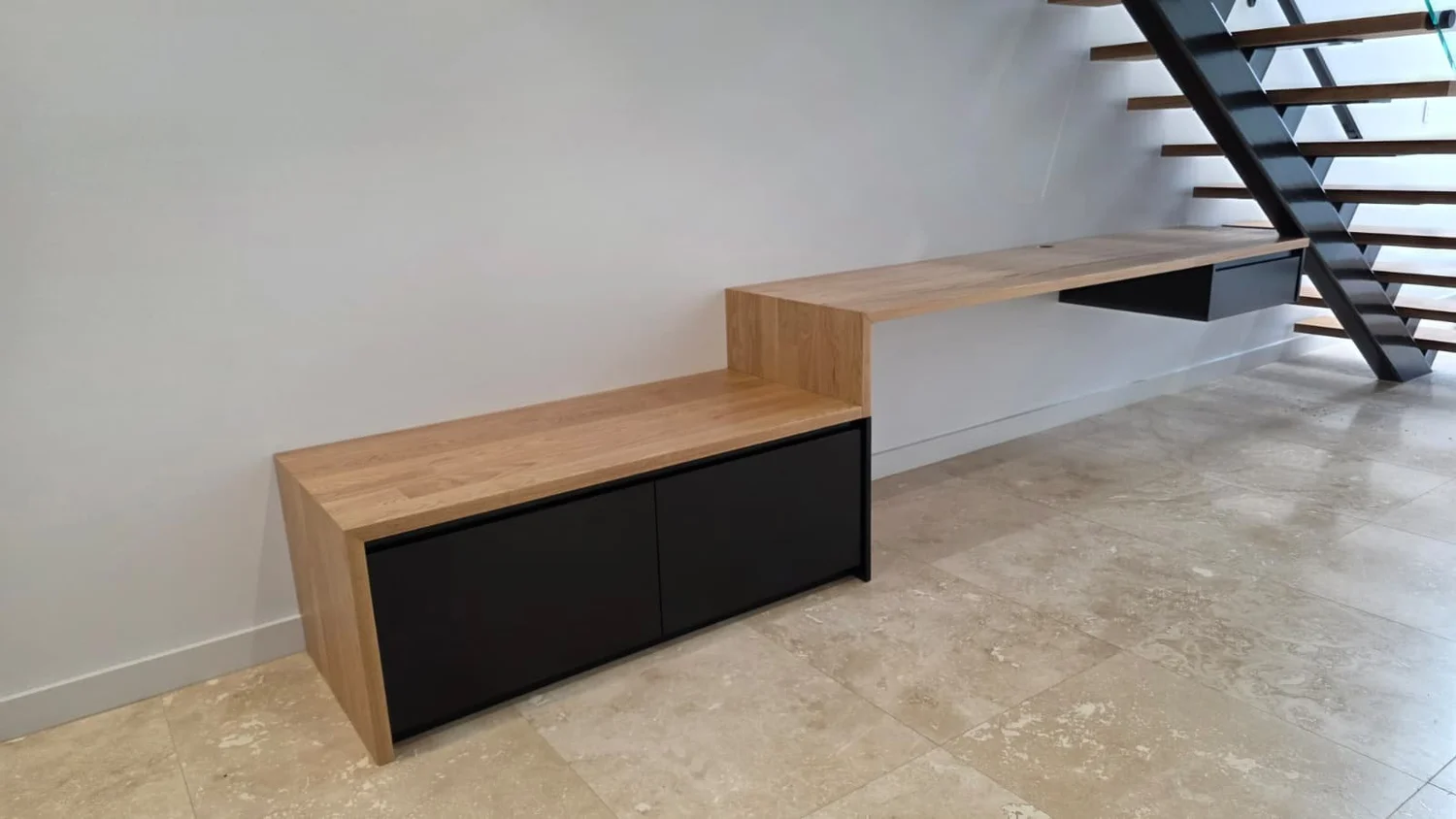
1. Under the stairs
The space beneath a staircase is the one most homes never use.
From our workshop: beneath an open steel-and-glass staircase, we built a desk that tracks the stair above it. The oak desktop stays dead level and stops where you can no longer sit upright; cupboards fill the tall end and a wall-hung drawer uses the lowest corner. In a terrace hallway, the same kind of void became storage shaped to every step.
Make it work: put the desk where the headroom is greatest, and let the storage step down with the treads.
2. An alcove
Recesses beside a chimney breast or a built-in wardrobe are often just the width of a good desk. Joinery fitted wall to wall leaves no gaps for dust or lost pens.
Make it work: run shelving to the ceiling above the desk. Walls in older Sydney homes are rarely true, so the joinery is scribed to fit — something only a measured build allows.

3. Beneath a window
A desk under a window takes the best light in the room and keeps the floor clear.
Make it work: keep the desktop below the sill and set drawers or cupboards either side. A screen in front of a bright window is hard on the eyes, so a laptop, or a monitor angled side-on, often suits this spot better.
4. Within a wardrobe run
In a bedroom or guest room, a bay of the wardrobe can become a desk. Behind closed doors it disappears at night — welcome when you sleep in the room you work in.
Make it work: plan the desk bay as part of the wardrobe design, with its own power and cable port. Our built-in wardrobes can include one.
5. A hallway or landing
A wide hallway or upstairs landing can take a shallow desk for paperwork, homework or a laptop.
Make it work: keep the depth modest and soften the corners so nobody catches a hip walking past. Wall-hung joinery keeps the floor clear.
6. A desk for two
"Built in desk for two people" is a search that keeps coming up — couples working from home, siblings doing homework side by side.
Make it work: put shared storage in the middle and personal drawers at each end, long enough that both chairs can roll back without bumping. Give each person their own power and cable port.
7. A desk behind doors
Sometimes the best office is one you cannot see. A desk behind tall doors in a living or dining room closes the working day away with the screen and the paperwork.
Make it work: choose doors that fold or slide back out of the way, so they never block the chair. Allow ventilation if a computer runs inside.
8. Within a media wall or library wall
When a media wall or a wall of bookshelves is already on your list, a desk can sit at one end of the same run, in the same finish, so the wall reads as one piece.
Make it work: keep the desk at working height — lower than a typical TV cabinet — and give it its own light.
What every small desk needs
The right height. WorkSafe Queensland recommends 680 to 720 mm for a fixed sitting desk.
Room for your knees. No drawers or supports where your legs go.
Power and data. Planned before the joinery goes in.
Somewhere to put things away. A small desk without drawers becomes a cluttered one.
Frequently asked questions
How small can a built-in desk be?
A laptop desk can be quite shallow and narrow; a desk for a large monitor needs more depth. We size it around what you actually use.
Is a built-in desk worth it in a small space?
Usually, yes. In a small space every centimetre counts, and built-in joinery uses the space freestanding furniture leaves empty.
Can a built-in desk be removed later?
Joinery is fixed to the wall, so it is not designed to move. It can be removed, but most people plan it as a permanent part of the room.
Do you build desks for kids' rooms?
Yes. A built-in desk with shelving and a wardrobe on one wall makes good use of a small bedroom.
Our advice for a small-space desk
Measure the space before you write it off. Let the joinery follow what the room gives you — the slope of a stair, the depth of a recess, the line of a sill — rather than forcing a standard desk into it. A restrained palette, a desktop set dead level and storage shaped by the space will give you a desk that feels as if it was always there.
See more in the home office and library gallery and on our home office joinery page. If there is a corner in your home waiting for a desk, we would be glad to come and measure it. Book a free measure and quote or call 0420 555 284.